📢 OPD closed (NAM Consultants & Raj Medicity) from 29 Oct after the morning OPD, on 30 & 31 Oct, and 1 Nov morning. OPD resumes Sunday, 1 November at 3 PM. For emergencies, go to the nearest hospital.
Two follow-along videos with on-screen timers: Kegel exercises to strengthen the pelvic floor for better bladder control, and gentle stretches for the back. Just 10–15 minutes a day.
● No equipment● Follow the timer● Men & women● 10–15 min a day
Dr. Nameirakpam ShantajitMBBS (SPMC Bikaner) · MS Surgery & M.Ch Urology (RIMS Imphal) · MMC Reg. No. MNP 150
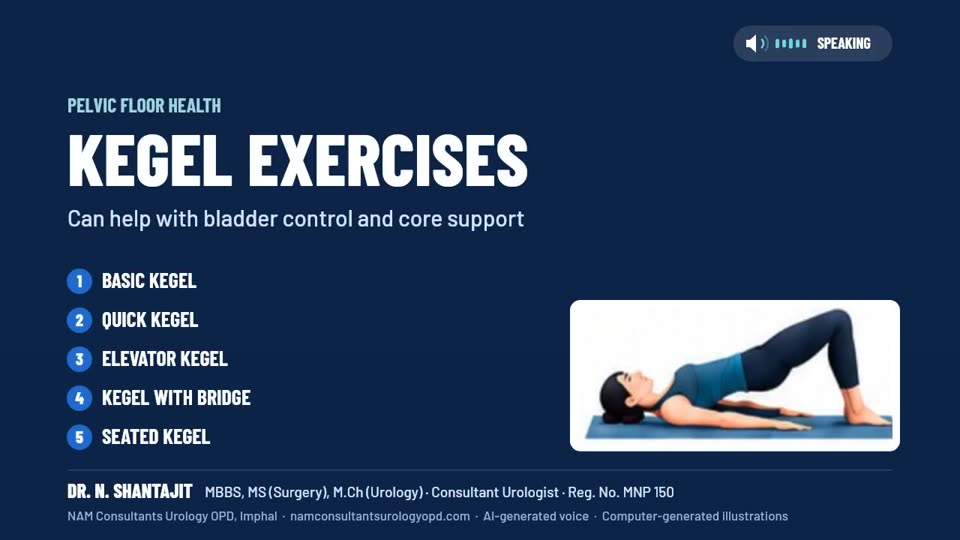
Two videos: 5 Kegel exercises (4 min) and 10 back stretches (9 min). Narration: AI-generated voice · illustrations: computer-generated.
5Kegel (pelvic floor) exercises
10Gentle back stretches
Daily10–15 minutes is enough
TimerFollow along on screen
Pelvic floor
Kegel exercises
The pelvic floor muscles support the bladder. Regular Kegel exercises can help with leaking urine when you cough, sneeze or lift, with urgency, and with bladder control after prostate surgery or childbirth — for both men and women.
Kegel exercises · 5 exercises · about 4 minutesLie on a mat or sit on a firm chair
Short, quick squeezes. These help when you cough, sneeze or lift.
3
Elevator Kegel
Hold 2–3 sec at each level · 5–10 times · 3 sets
Tighten a little, then more, then more — like a lift going up floor by floor — then come down slowly.
4
Kegel with bridge
Hold 3–5 sec · 10–15 times · 3 sets
Squeeze the pelvic floor and lift your hips. Keep breathing; lower slowly.
5
Seated Kegel
Hold 3–5 sec · 10–15 times · 3 sets
Sit tall on a firm chair, feet flat. Can be done anywhere — at work, in the car or watching TV.
🎯 Find the right muscles
They are the muscles you would use to stop passing urine midway. Use this only once to identify them — don't practise while passing urine.
🌬️ Keep breathing
Don't hold your breath. Keep your tummy, buttocks and thighs relaxed — only the pelvic floor works.
📅 Be regular
Do them every day. Many people notice a difference after several weeks of regular practice.
After prostate (TURP) or other urinary surgery, start Kegels only when your doctor advises — usually after the catheter is out.
A healthy spine
Back stretches
Ten gentle stretches that can help ease muscle stiffness and back pain, and improve posture and flexibility. Move slowly, breathe, and never force a stretch.
Back stretches · 10 stretches · about 9 minutesUse a mat · a wall for the last stretch
1
Cat-cow
10–15 breaths · 3 sets
Feel it in: Whole spine
2
Child's pose
Hold 20–30 sec · 3 sets
Feel it in: Lower back & hips
3
Knee to chest
20–30 sec each side · 3 sets
Feel it in: Lower back & buttock
4
Lower trunk twist
20–30 sec each side · 3 sets
Feel it in: Lower back & sides
5
Downward dog
Hold 20–30 sec · 3 sets
Feel it in: Back, hamstrings & calves
6
Cobra stretch
Hold 20–30 sec · 3 sets
Feel it in: Front of trunk & lower back
7
Seated forward fold
Hold 20–30 sec · 3 sets
Feel it in: Back & hamstrings
8
Side stretch
20–30 sec each side · 3 sets
Feel it in: Sides of the trunk
9
Thread the needle
20–30 sec each side · 3 sets
Feel it in: Upper back & shoulders
10
Wall spine stretch
Hold 20–30 sec · 3 sets
Feel it in: Posture & upper back
Know the difference
Back pain or kidney pain?
Stretching helps muscle pain. Pain from a kidney stone or kidney infection is different — it needs a doctor, not exercise.
💪 Usually muscle-related
Dull ache or stiffness in the lower back
Worse with certain movements or sitting long
Eases with rest, warmth and gentle stretching
🫘 Could be kidney-related — see a doctor
Severe pain in the side that comes in waves, often spreading to the groin
With vomiting, blood in urine, or burning while passing urine
Stop exercising if pain gets worse. Go to the nearest hospital for severe pain, fever with chills, being unable to pass urine, or new weakness or numbness in the legs, or loss of bladder or bowel control. If you are pregnant, have had recent surgery, or have a medical condition, check with your doctor before starting.
Questions
Frequently asked questions
Can men do Kegel exercises?
Yes. The pelvic floor supports the bladder in men too. Kegels can help with dribbling after passing urine and with bladder control after prostate surgery, when your doctor advises.
How long before Kegels help?
It varies. Many people notice a difference after several weeks of regular daily practice. Keep going — the benefit comes from doing them consistently.
Should I do Kegels while passing urine?
No. Stopping the flow once helps you find the right muscles, but practising while passing urine can stop the bladder emptying properly.
How often should I do the back stretches?
Once a day is a good start. Hold each stretch gently — mild pulling is fine, sharp pain is not. Stop if your pain gets worse.
Can exercises replace treatment for leaking urine or back pain?
They help many people, but they are not a substitute for a check-up. If leakage, urgency or pain continues, or if you have blood in urine or fever, see a doctor.
Book a consultation
NAM Consultants, Singjamei: mornings daily 6:00–9:30 AM (Mar–Oct) / 6:30–9:30 AM (Nov–Feb), evenings 4–6 PM Mon–Sat · Raj Medicity Hospital: Mon–Sat 11 AM–1 PM