NAMNAM ConsultantsUrology OPD · Imphal, Manipur
Home › Prostate & TURP
Prostate Care · Imphal

Enlarged prostate,
a clearer flow.

What an enlarged prostate (BPH) does, the tests we use, when tablets are enough — and what to expect from TURP surgery and recovery.

● In-house uroflowmetry ● Medicines first ● TURP — no external cut ● Usually spinal anaesthesia
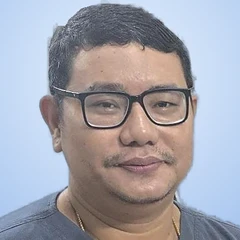
Dr. Nameirakpam Shantajit
Dr. Nameirakpam ShantajitMBBS (SPMC Bikaner) · MS Surgery & M.Ch Urology (RIMS Imphal) · MMC Reg. No. MNP 150

▶ How bipolar TURP is done — 1¾-minute animation with voice, including real endoscopic views. Download to share on WhatsApp.

No cutDone through the urinary passage
SpinalUsually waist-down anaesthesia
2–3 daysCatheter, and usual hospital stay
~4 weeksAvoid heavy lifting and straining
Symptoms

Signs of an enlarged prostate

The prostate grows with age in most men. When it presses on the urine passage, these are the common signs. They should be checked rather than assumed to be "just age".

💧

Weak or slow stream

Urine flow is thinner, slower, or stops and starts.

🌙

Waking at night

Getting up two or more times a night to pass urine.

⏱️

Frequency & urgency

Passing urine often, or a sudden need to go.

😣

Straining to start

Waiting or pushing before urine begins to flow.

🔁

Not emptying fully

Feeling the bladder is still full, or dribbling at the end.

🚫

Unable to pass urine

Painful, swollen lower belly — this is an emergency.

Prostate symptom score

Check your prostate symptoms: IPSS score

The International Prostate Symptom Score (IPSS) is the standard questionnaire urologists use worldwide. Answer 7 simple questions about the past month — it takes about 2 minutes. You can then print it, save it as PDF, or send it on WhatsApp, and bring it to your visit. Repeat it after treatment to see how much you have improved.

0 of 8 answered
Score: –
1Incomplete emptyingHow often have you had a feeling of not emptying your bladder completely after you finish passing urine?
2FrequencyHow often have you had to pass urine again less than two hours after you last passed urine?
3IntermittencyHow often have you found you stopped and started again several times while passing urine?
4UrgencyHow often have you found it difficult to hold (postpone) passing urine?
5Weak streamHow often have you had a weak urine stream?
6StrainingHow often have you had to push or strain to begin passing urine?
7Night-time (nocturia)How many times did you most typically get up at night to pass urine, from going to bed until getting up in the morning?
★Quality of lifeIf you had to spend the rest of your life with your urinary condition just as it is now, how would you feel about that?
–out of 35Answer all 7 questions
0 · Mild (0–7)Moderate (8–19)Severe (20–35) · 35
Emptying (voiding) score–Q1, 3, 5, 6
Filling (storage) score–Q2, 4, 7
Quality of life–0 = delighted … 6 = terrible
Your result will appear here once all 7 questions are answered.

Your answers stay on your own device — nothing is sent anywhere unless you choose WhatsApp. To save as a PDF, tap "Print / Save as PDF" and choose Save as PDF as the printer. The IPSS describes how much your symptoms bother you; it does not diagnose the cause, and a high score can also come from problems other than the prostate. It is always read together with an examination, urine test, flow test and ultrasound.

Tests

Checking the prostate, simply

Most tests are done at the clinic in the same visit, so a plan can be made straight away.

Examination & score

A history, a symptom questionnaire and a gentle prostate examination.

Ultrasound

Prostate size, kidneys and bladder, and how much urine is left after passing urine.

Uroflowmetry

In-house flow test — you simply pass urine into a special funnel. Results in minutes.

Blood & urine

Urine test for infection, kidney function, and PSA where appropriate after discussion. About PSA →

Treatment

A step-by-step approach

Most men start with the simplest option. Surgery is considered only when it is really needed.

Step 1

Simple changes

Less fluid in the late evening, less tea, coffee and alcohol at night, and not holding urine too long.

Step 2

Medicines

Tablets that relax the prostate to improve flow, and others that slowly shrink a larger prostate. Taken long term and reviewed regularly.

Step 3

TURP surgery

When medicines aren't enough, or complications develop — removes the blocking tissue for a lasting improvement in flow.

TURP is usually advised if you have

🚫Urine retention, or a catheter that can't be removed
🦠Repeated urine infections
🪨Bladder stones from incomplete emptying
🩸Repeated bleeding from the prostate
🫘Back-pressure affecting the kidneys
💊Troublesome symptoms despite medicines
The Operation

What happens during TURP

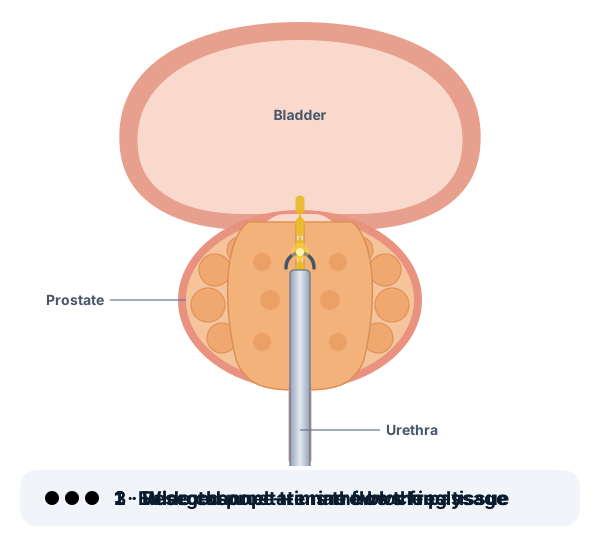
Transurethral resection of the prostate removes the inner part of the prostate that blocks urine flow, using a thin instrument (resectoscope) passed through the urinary passage. There is no cut on the body.

Animation of the three stages of TURP
🏥

Where & how

At Raj Medicity Hospital, usually under spinal anaesthesia (numb from the waist down). The operation itself typically takes about an hour.

✂️

Trimming the blockage

A fine bipolar loop, working in saline, trims the obstructing tissue in tiny pieces and seals small vessels. The pieces are washed out and sent for testing.

🚿

Catheter afterwards

A catheter with gentle bladder washing is kept for about 2–3 days while the area settles.

Recovery timeline

1
Day of surgeryCatheter in, fluids through a drip and washing
2
Day 2–3Catheter removed, passing urine, usually home
3
First weeksSome burning, frequency, blood-tinged urine on and off
4
~4–6 weeksBack to full activity; follow-up with flow test
Possible effects to know aboutMost men notice that semen goes backwards into the bladder (retrograde ejaculation) — harmless, but little or no fluid at climax. Less commonly: bleeding, infection, temporary leakage, or a narrowing of the passage later. These are discussed in detail before surgery.
Helping your recovery
  • Drink plenty of water unless told otherwise
  • Avoid constipation and straining
  • No heavy lifting, cycling or long bumpy rides for about 4 weeks
🖨️ Print the "After TURP" leaflet
Still need PSA checks after TURPTURP does not remove the whole prostate — the outer part, where most cancers begin, remains. Keep up PSA checks as advised; a new baseline is usually taken about 3 months after surgery. About PSA →
🚑

Go to the nearest hospital emergency if you have

  • Unable to pass urine, with a painful swollen lower belly
  • Heavy bleeding with clots, or a blocked catheter
  • Fever with chills
WhatsApp numbers and the chatbot are not emergency services.
Questions

Frequently asked questions

Is TURP a major operation?

It is a standard operation done through the urinary passage with no external cut, usually under spinal anaesthesia. Most patients stay 2–3 days and go home after the catheter is removed.

Will TURP affect erections?

In most men erections stay as they were before surgery. Retrograde ejaculation — little or no semen at climax — is common after TURP and is harmless.

Can medicines alone treat an enlarged prostate?

Yes, for many men. Tablets improve symptoms in most patients with mild to moderate problems. Surgery is considered when medicines are not enough or complications develop.

How long does the catheter stay after TURP?

Usually about 2–3 days. Once the urine is clear, the catheter is removed and you pass urine normally before going home.

Can the prostate grow back after TURP?

The remaining prostate can slowly enlarge again over many years, so a small number of men need treatment again in the future. Regular follow-up helps.

Myth: “After TURP, I can't get prostate cancer.” Is that true?

No — this is a common myth. TURP removes only the inner part of the prostate that blocks urine flow. The outer part of the prostate, where most prostate cancers start, is left behind, so cancer can still develop later. Continue PSA checks as advised. Because PSA falls after TURP, a new baseline PSA is usually checked about 3 months after surgery, and any later rise is taken seriously. The tissue removed during TURP is also tested, and occasionally finds an early cancer.

Does an enlarged prostate mean cancer?

No. Benign enlargement (BPH) is not cancer and does not turn into cancer, but both can occur in the same age group. A PSA test and examination help decide if further tests are needed. The tissue removed during TURP is also tested.

I suddenly can't pass urine. What should I do?

This is urinary retention and needs urgent care — go to the nearest hospital emergency, where a catheter can relieve it. Then see us to plan further treatment.

What is the IPSS score?

The International Prostate Symptom Score is a standard 7-question questionnaire about urinary symptoms over the past month, scored from 0 to 35: 0–7 mild, 8–19 moderate and 20–35 severe, plus a quality-of-life question. It helps decide treatment and track improvement. You can fill it in on this page, then print it or save it as a PDF.

Can a high IPSS score mean something other than the prostate?

Yes. Similar symptoms can come from a urethral stricture, overactive bladder, bladder stones, infection, diabetes or nerve problems. That is why the score is always checked together with an examination, urine test, flow test and ultrasound.
Book a consultation

NAM Consultants, Singjamei: mornings daily 6:00–9:30 AM (Mar–Oct) / 6:30–9:30 AM (Nov–Feb), evenings 4–6 PM Mon–Sat · Raj Medicity Hospital: Mon–Sat 11 AM–1 PM

Medically reviewed by Dr. Nameirakpam Shantajit, M.Ch Urology (MMC Reg. No. MNP 150) · Last reviewed: 10 October 2026

Just say "Hi" on WhatsApp+91 70850 51135 · Chatbot 24/7 · Book & queries Clinic WhatsApp81328 57130