NAMNAM ConsultantsUrology OPD · Imphal, Manipur
Home › Prostatitis & prostate abscess
Prostate Infection & Pain · Imphal

Prostatitis & prostate abscess:
infection and pain in the prostate.

From a sudden infection with fever, to a pus pocket (abscess) that needs drainage, to long-standing pelvic pain — how each is diagnosed on ultrasound, CT or MRI, and how it is treated.

● Same-visit ultrasound● TRUS-guided drainage● Chronic pelvic pain care
Dr. Nameirakpam Shantajit
Dr. Nameirakpam ShantajitMBBS (SPMC Bikaner) · MS Surgery & M.Ch Urology (RIMS Imphal) · MMC Reg. No. MNP 150
PROSTATE ABSCESS Bladder Prostate Urethra Abscess(pus pocket)

Illustration — an abscess is a pocket of pus inside the prostate.

Acute prostatitisFever, burning, painful urination
AbscessPus pocket — often needs drainage
DiabetesThe biggest risk for abscess
Chronic painCommon, and manageable
Types

Four kinds of prostatitis

Doctors group prostatitis into four types (NIH classification). Knowing which one you have decides the treatment — most men with long-standing symptoms do not have an infection.

Type I

Acute bacterial prostatitis

Sudden infection with fever and painful urination. Needs prompt antibiotics.

Type II

Chronic bacterial prostatitis

Repeated infections from the same germ hiding in the prostate.

Type III

Chronic pelvic pain syndrome

Pain lasting 3 months or more, usually without infection. The most common type — about 9 in 10.

Type IV

No-symptom inflammation

Found by chance on tests or biopsy. Usually needs no treatment.

Acute prostatitis & abscess

When infection forms pus

🌡️

High fever with chills

Often with body ache — the prostate is acutely infected.

🔥

Burning, painful urination

Frequent, urgent and painful passing of urine.

🪑

Pain between the legs or in the back passage

Pain in the perineum, rectum or lower back, worse on sitting.

🚱

Difficulty or inability to pass urine

The swollen prostate can block the flow completely.

⏳

Fever not settling after 2–3 days of antibiotics

The classic sign that an abscess may have formed — needs a scan.

💉

Diabetes, catheter or a recent prostate procedure

Diabetes, a long-term catheter, recent biopsy or TURP, and low immunity all raise the risk.

Who is at risk of an abscess
  • Diabetes — the most common risk factor
  • Long-term catheter or recent instrumentation
  • Recent prostate biopsy
  • Weak immunity, kidney or liver disease
  • Untreated or partly treated acute prostatitis
Good to know
  • The prostate is examined gently — vigorous prostate massage is avoided in acute infection
  • PSA rises during infection — it is rechecked only after recovery
  • Prostatitis is not prostate cancer and does not cause it
Imaging findings

What an abscess looks like on USG, CT and MRI

A scan is needed when an abscess is suspected — especially in diabetics, or when fever does not settle on antibiotics. Small abscesses can be missed on an abdominal ultrasound alone.

Dark cavity,thick wall Orange = Doppler flow in the wall only

Transrectal ultrasound (TRUS)

First choice to confirm an abscess — and to guide drainage.

  • Dark (hypo- or anechoic) area in the prostate
  • Thick, irregular wall; may have partitions (septations)
  • Debris or moving echoes inside (pus)
  • Doppler: no flow inside — increased flow in the wall
  • Abdominal ultrasound: shows retention and residual urine, but may miss a small abscess
Pubic boneRectum Low-densitypockets withbright rim

CT scan with contrast

Shows the full extent — useful when very unwell or for planning.

  • Low-density (fluid) collection(s) in the prostate
  • Bright rim around the pocket (rim enhancement)
  • Often several pockets (multiloculated)
  • Shows spread to seminal vesicles, around the rectum or into the pelvis
  • Shows gas, if present
DWIBright on T2(fluid / pus) Bright on DWI

MRI pelvis

The most detailed picture, in selected cases.

  • Bright on T2, dark on T1 (fluid/pus)
  • Rim enhancement after contrast
  • Very bright on diffusion (DWI) — restricted diffusion
  • Helps tell an abscess from other problems, including tumours

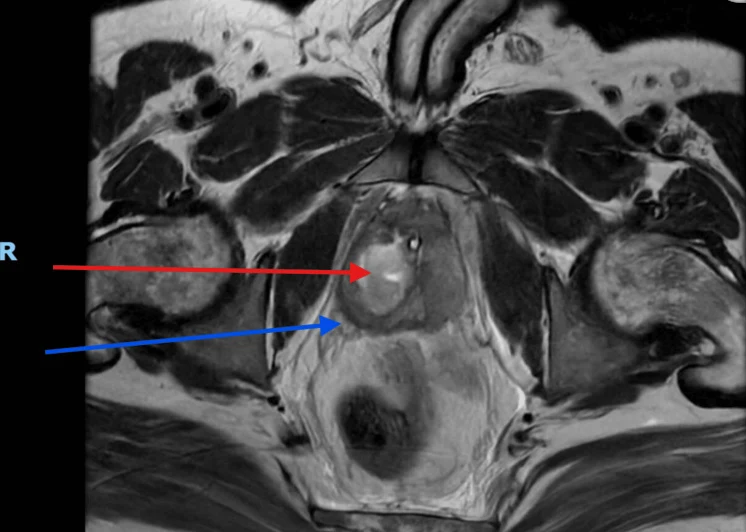
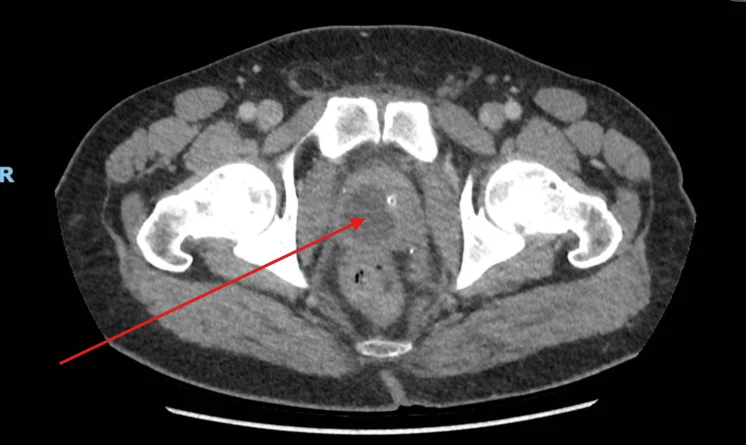
Real scans of a prostate abscess

From a published case of a 45-year-old man with a prostate abscess, treated with drainage.

Contrast CT of the pelvis, axial view: a low-density prostate abscess marked with a red arrow
Real CTCT pelvis (axial), day of admission. Red arrow: the abscess — a darker, low-density area in the prostate. R = patient's right.
T2-weighted MRI of the prostate, axial view: abscess marked with a red arrow and extension outside the prostate with a blue arrow
Real MRIMRI prostate (axial T2), day 5. Red arrow: the abscess inside the prostate. Blue arrow: spread outside the prostate.

Images: Rana N, Prakash A. Prostatic Abscess in a 45-Year-Old Male: Atypical Presentation and Successful Management With Open Transperineal Drainage. Cureus 2025:e95656. doi:10.7759/cureus.95656 — used under CC BY 4.0; cropped from the original figures. View article

The coloured drawings above are schematic illustrations of typical findings. Findings are always interpreted together with the examination and tests.

Management

Treating infection and abscess

Acute bacterial prostatitis

Antibiotics for 2–4 weeks

Urine (and blood) culture first, then an antibiotic that reaches the prostate. Hospital admission and injections if very unwell. If urine is blocked, a catheter — often through the lower belly (suprapubic).

Small abscess (under ~1 cm)

Antibiotics, close watch

May settle with antibiotics alone, with strict sugar control and a repeat ultrasound to make sure it is shrinking.

Larger or multiple abscess

Drainage

TRUS-guided needle aspiration or a drain (through the back passage or the skin between the legs), or transurethral deroofing — opening the abscess from inside with a scope, especially for large, multiple or recurrent pockets.

🩸

Diabetic with fever and painful urination? Don't delay.

Prostate infection in diabetics turns into an abscess more often. Early culture, the right antibiotic, sugar control and a scan if fever persists can prevent serious illness.

🚑

Go to the nearest hospital emergency if you have

  • Unable to pass urine
  • High fever with chills and shivering
  • Fever not improving after 2–3 days of antibiotics
  • Drowsiness, confusion or low blood pressure
  • Severe pain in the back passage with fever
WhatsApp numbers and the chatbot are not emergency services.
Chronic prostatitis

Chronic pelvic pain syndrome (CPPS)

Read our awareness page on chronic pelvic pain & bladder pain syndrome →

📍

Pain in the pelvis

Between the legs, testes, tip of the penis, lower belly or lower back — for 3 months or more.

💔

Pain on or after ejaculation

A common and distressing symptom.

🚻

Urinary symptoms

Frequency, urgency, weak or interrupted stream, burning without infection.

🧠

Stress and sleep

Long-standing pain often affects mood and sleep — and stress makes the pain worse.

The UPOINT approach — treating what your symptoms need

There is no single medicine for CPPS. Your symptoms are sorted into six areas, and each one that applies gets its own treatment. A combined plan works best.

U

Urinary

Frequency, urgency, weak flow — alpha-blocker medicines, bladder habits

P

Psychosocial

Stress, worry, low mood make pain worse — counselling, relaxation

O

Organ

Tender prostate — anti-inflammatory and plant-based (e.g. quercetin) options

I

Infection

Only if a germ is proven — a targeted antibiotic course

N

Nerves

Pain beyond the pelvis — nerve-pain medicines, general measures

T

Tenderness

Tight, tender pelvic muscles — pelvic floor physiotherapy, warm sitz baths

What helps day to day
  • Warm sitz baths; a soft or cut-out cushion
  • Avoid long sitting and long cycling rides
  • Cut down tea, coffee, alcohol and very spicy food if they worsen symptoms
  • Regular exercise, walking and relaxation
  • Treat constipation
Reassurance
  • CPPS is not cancer and does not lead to cancer
  • It is not passed to your partner
  • Repeated antibiotics don't help when there is no infection
  • Most men improve over time with a combined plan
Chronic prostatitis score (NIH-CPSI)

Track your pelvic pain: NIH-CPSI score

The NIH Chronic Prostatitis Symptom Index is the standard score for chronic prostatitis / chronic pelvic pain syndrome. It measures pain, urinary symptoms and impact on your life over the last week. Repeat it every few weeks to see how treatment is working — a fall of 6 points or more is usually a meaningful improvement.

0 answered
Score: –
Pain or discomfort — in the last week, have you had pain or discomfort in…
1aBetween the back passage and testiclesThe perineum.
1bTesticlesEither or both testicles.
1cTip of the penisNot related to passing urine.
1dBelow the waistIn the pubic or bladder area.
2aBurning on passing urineIn the last week, have you had pain or burning during urination?
2bPain with ejaculationIn the last week, have you had pain or discomfort during or after sexual climax (ejaculation)?
3How oftenHow often have you had pain or discomfort in any of these areas over the last week?
4Average painWhich number best describes your AVERAGE pain or discomfort on the days you had it, over the last week? (0 = no pain, 10 = worst pain imaginable)
Urination
5Incomplete emptyingHow often have you had a feeling of not emptying your bladder completely after passing urine, over the last week?
6FrequencyHow often have you had to pass urine again less than two hours after you last passed urine, over the last week?
Impact of symptoms
7Daily activitiesHow much have your symptoms kept you from doing the things you would usually do, over the last week?
8Thinking about itHow much did you think about your symptoms, over the last week?
Quality of life
9Quality of lifeIf you had to spend the rest of your life with your symptoms just the way they have been during the last week, how would you feel about that?
–out of 43Answer all questions
Mild (0–14)Moderate (15–29)Severe (30–43)
Pain–Q1–4
Urinary–Q5–6
Quality-of-life impact–Q7–9
Your result will appear here once all questions are answered.

Your answers stay on your device unless you print or send them. The NIH-CPSI measures symptoms and their impact; it does not diagnose the cause. Fever, inability to pass urine or blood in urine need prompt medical attention whatever the score.

Evaluation

How prostatitis is assessed

History & symptom score

Including the NIH chronic prostatitis symptom index (NIH-CPSI) for long-standing symptoms.

Urine tests & culture

And the two-glass test (urine before and after prostate massage) for chronic infection — not done in acute infection.

Flow test & ultrasound

In-house uroflowmetry and residual urine; TRUS, CT or MRI if an abscess is suspected.

Other checks

Sugar, and tests to rule out stricture, stones or other causes when symptoms don't fit.

Questions

Frequently asked questions

What is a prostate abscess?

A pocket of pus inside the prostate, usually following an acute prostate infection. It is more common in people with diabetes, a catheter or a recent prostate procedure, and often needs drainage as well as antibiotics.

How is a prostate abscess found?

A transrectal ultrasound (TRUS) is usually the best test and can also guide drainage. CT or MRI shows how far it has spread. An ordinary abdominal ultrasound may miss a small abscess.

Does every prostate abscess need an operation?

No. Very small abscesses may settle with antibiotics and close monitoring. Larger or multiple abscesses are drained — with a needle under ultrasound guidance, or by opening them from inside with a scope (transurethral deroofing).

How long are antibiotics needed for acute prostatitis?

Usually 2 to 4 weeks, chosen according to the urine culture. Stopping early can lead to chronic infection or an abscess.

Is chronic prostatitis an infection?

Usually not. About 9 in 10 men with long-standing prostate-area pain have chronic pelvic pain syndrome, which is not caused by an infection, so repeated antibiotics don't help.

Can prostatitis cause prostate cancer?

No. Prostatitis does not cause cancer. It can raise the PSA level for a while, so PSA is rechecked after the infection has settled.

Can chronic prostatitis be cured?

Many men improve a great deal with a combined plan — medicines for urinary symptoms, pelvic floor physiotherapy, warm baths, stress management and lifestyle changes. Symptoms may come and go, but they usually become much easier to manage.

Is prostatitis passed to my partner?

Chronic pelvic pain syndrome is not contagious. Acute bacterial prostatitis is usually caused by bowel germs, not a sexually transmitted infection, though in younger men an STI may be checked for.

What is the NIH-CPSI score?

The NIH Chronic Prostatitis Symptom Index is a standard questionnaire for chronic prostatitis / chronic pelvic pain syndrome. It scores pain (0–21), urinary symptoms (0–10) and quality-of-life impact (0–12), for a total of 0–43. A fall of about 6 points or more usually means a meaningful improvement. You can fill it in on this page and print or save it.

Book a consultation

NAM Consultants, Singjamei: mornings daily 6:00–9:30 AM (Mar–Oct) / 6:30–9:30 AM (Nov–Feb), evenings 4–6 PM Mon–Sat · Raj Medicity Hospital: Mon–Sat 11 AM–1 PM

Medically reviewed by Dr. Nameirakpam Shantajit, M.Ch Urology (MMC Reg. No. MNP 150) · Last reviewed: 10 October 2026

Just say "Hi" on WhatsApp+91 70850 51135 · Chatbot 24/7 · Book & queries Clinic WhatsApp81328 57130